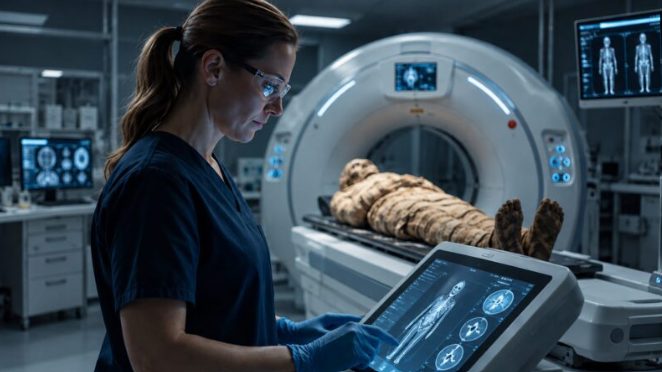
Archaeologists found a mummy over 3,200 years old in a sealed stone tomb, but during the CT scan, the scientist noticed a strange detail inside the body. When she enlarged the image of the chest, the monitor suddenly began emitting an alarm signal, and the woman turned pale and ran out of the laboratory 😨
The mummy was discovered during excavations of an ancient burial site in the middle of the desert.
The archaeologists had been working there for several months and were almost about to finish the expedition when, under one of the ruined walls, they found a narrow passage completely covered with sand and stones.
Behind it was a small tomb.
What was strange was that over thousands of years, no one seemed to have entered it. The stone door remained sealed, the jewels lay in their places, and in the center of the room stood a massive sarcophagus.
But what surprised the researchers even more was something else.
On the inner side of the door, the same drawing was repeated several times: a human figure, around which other people lay.
The scientists decided that this was an ordinary depiction of death or the afterlife, so they did not attach much importance to it.
The sarcophagus was opened. Inside was the mummy of a man of about forty years old.
The body was preserved so well that even through the darkened skin, one could distinguish the facial features and fingers. The man was wrapped in several layers of cloth, and near his head lay a small wooden amulet.
The mummy was carefully transported to the laboratory. The researchers wanted to find out what this man ate, what injuries he had sustained during his life, and, most importantly, what he died from.
No one intended to unwrap the body. It was placed in a special scanner that allowed them to look inside without damaging the remains.
The first minutes went completely normally.
On the screen gradually appeared the bones, the spine, the ribs, and the remains of the internal organs.
The scientist calmly switched the images one after another, but while viewing one image, the monitor suddenly began emitting an alarm signal, and the woman turned pale and ran out of the laboratory after seeing exactly what had appeared on the screen… 😱😳
The continuation of the story can be found in the first comment 👇👇
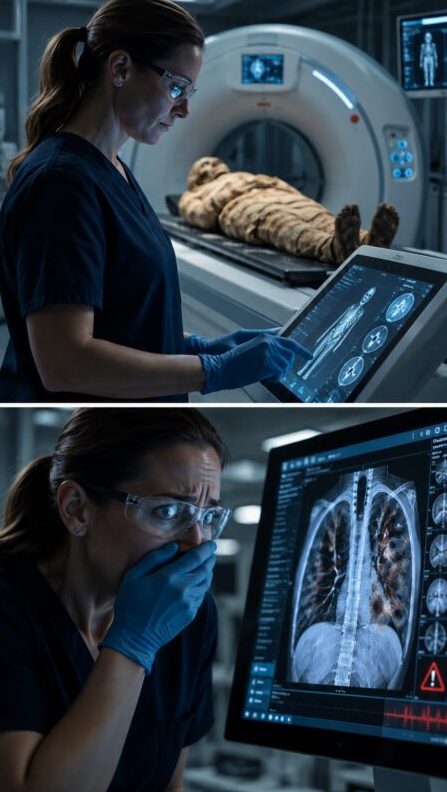
The scientist calmly switched the images one after another until she reached the chest. And there she stopped.
In the lungs were strange dark areas. At first, the woman decided that these were ordinary changes that had occurred in the body over thousands of years.
She enlarged the image. Then she opened the next scan. There were the same traces.
Moreover, they were arranged too evenly, as if the disease had managed to affect both lungs during the man’s lifetime.
The scientist frowned and called over her colleague.
— Look here.
The man approached the monitor. For a few seconds, they silently examined the images.
— Maybe he was simply ill before his death? — the colleague suggested.
But the woman was already opening the data from another part of the body.
She saw enlarged lymph nodes, and then several more changes that did not fit well with ordinary inflammation of the lungs.
Something alerted her. The scientist quickly walked over to the table where the photographs from the tomb lay and found the picture of that same wall.
The human figure. And around it lay dozens of people. Now the drawing looked completely different. Perhaps it was not a depiction of the afterlife. Perhaps the ancient people were trying to warn the others.
The woman returned to the computer and began comparing what she had seen with descriptions of ancient diseases.
A few minutes later, her face changed. According to one version, the man could have died from an extremely contagious infection capable of spreading quickly between people and severely affecting the lungs.
But the most terrible thing was not that.
The mummy was found in a completely closed tomb.
If traces of the ancient pathogen had indeed been preserved inside, no one could immediately say whether it was capable of posing a danger after thousands of years.
And the sarcophagus had been opened several hours earlier. Without protective suits. Without isolating the room. Six people had already been in the laboratory. The scientist slowly looked at the mummy.
At that moment, the scan ended, and the monitor suddenly emitted several loud signals. The woman flinched. She looked once more at the image of the lungs, then at her own gloves.
And suddenly she remembered that a few minutes earlier, when she was adjusting the cloth near the mummy’s head, a small cloud of ancient dust had risen into the air.
At that time, no one had even paid attention to it.
Now she became frightened.
— No one come in! — she shouted.
The woman sharply stepped away from the table, opened the door, and ran out of the laboratory. Colleagues in the corridor looked at her in surprise, but she did not even stop.
She was running toward the emergency button so that the room would be immediately isolated. Because if her guess was correct, the main mistake of the archaeologists had not occurred four thousand years ago.
It occurred this morning, when they opened the tomb that the ancient people had deliberately sealed forever.