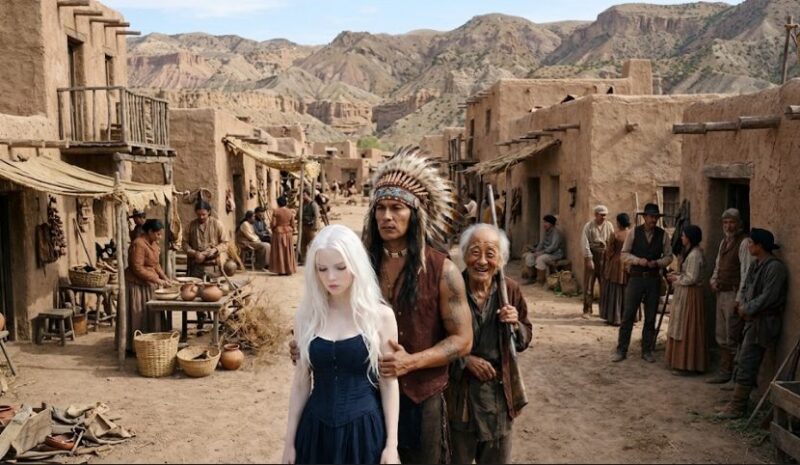
Her father gave her to the fearsome Apaches only because she was born an albino… but no one even suspected what would happen the moment she first crossed the threshold of their home. 😲😨
Lucia had understood too early that in their small settlement people do not forgive what seems foreign to them.
Her skin was almost transparent under the scorching sun, and her light eyes seemed unusual and even frightening to those who in 1876 had never yet seen a person with albinism.
That was enough for the girl to begin to be avoided. On the square they spoke of her in whispers, as if of a bad sign.
Some considered her a harbinger of misfortune, others a shame it was better not to speak of aloud. The women crossed themselves when she passed by. The children repeated cruel rumors without understanding their meaning.
And her father, Joaquin, looked at his daughter as if she were a heavy burden he could not get rid of.
When her mother died, Lucia was still a child, and the house finally lost its warmth. Her father rarely raised a hand to her, but his indifference wounded no less.
He answered with cold silence, avoided her gaze, and by his entire behavior made it clear: life could have turned out far easier if she had never been born at all.
Lucia learned early to expect nothing. Her only consolation was the books her mother had once hidden in an old chest.
The girl read them in secret, sometimes wrote short notes, as if talking to herself. On those pages she could be anyone — just not that mistake that those around her considered her to be.
However, Joaquin’s difficulties were not limited to his dislike of his daughter. He owed a large sum to Vicente Salazar — the most influential man in the area. This merchant knew how to smile when he signed papers capable of destroying another person’s life. Debts, poor harvests, and constant drunkenness had gradually cornered Joaquin. And then he chose the most shameful way out.
He decided to give Lucia away.
The decision was made without her. Joaquin, Vicente, and the local priest Father Esteban quickly came to an agreement. Their plan seemed simple and convenient: Lucia, the albino girl whom the village avoided anyway, would be married to Nantan — an Apache living in the nearby hills — and he would pay off Joaquin’s debts.
His name had inspired fear for years. People spoke of him as a savage, a dangerous bandit. The stories multiplied, but no one tried anymore to understand how much truth was in them.
Lucia learned of the impending marriage late in the evening, when her father returned home, smelling of mezcal and hopelessness. He gave no explanations — only a dry order.
— In a week you are getting married.
Lucia slowly raised her eyes from the book.
— To whom?
— To an Apache.
The word sounded heavy. In the first moment she thought of escape, then of protest, of screaming. But she understood almost immediately: she had nowhere to run. In a world where a woman alone means nothing, such attempts end quickly and badly. Nevertheless, she looked her father straight in the eye.
— How much did you get for me?
Joaquin was silent. And that silence was more eloquent than any words.
The following days turned into a strange and humiliating preparation. She was given old dresses, read meaningless instructions, forced to listen to prayers.
Father Esteban assured her that such was God’s will. Vicente Salazar looked pleased, as if he had concluded a profitable deal.
No one asked what Lucia herself wanted. No one was interested in her fear. But inside her another feeling gradually arose — not hope, not yet, but a cold clarity. If she was going to be torn from her former life, she would at least enter the new one with open eyes.

The wedding turned out to be short and awkward. No flowers, no music — only a few people watching what was happening with curiosity and relief, as if witnessing the disappearance of someone else’s problem.
It was there that Lucia first saw Nantan. He stood next to her — tall, silent, with a dark braid falling down his back.
His face was stern and sunburned, but there was not in it the cruelty that had been described to her. He did not smile and almost did not look at her. When the ceremony ended, he simply extended his hand, helping her get on the horse.
The road to his house passed in silence. Lucia sat tensely, expecting the worst. Every sound seemed a harbinger of trouble. But when they arrived, Nantan first of all showed her a small room.
— Here you will rest, — he said in rough but understandable Spanish. — I will sleep outside.
Lucia looked at him in surprise.
— Outside?
— Until you yourself decide otherwise. I am not going to force you.
These words stunned her more than any threat. For several days in a row she had prepared for cruelty and humiliation. And now the man whom everyone called a savage had given her what she had never received before.
A choice…
But three months later, in the settlement everyone was in shock from the spreading rumors about what had happened to Lucia at the moment when she crossed the threshold of her husband’s house…
READ THE FULL STORY BELOW. 👇
That word rang in her head for a long time, like something impossible. Lucia stood in the doorway of the small room and for the first time in many years did not feel that she had been cornered.
She looked at Nantan and tried to understand how it had happened that the man whom everyone called a cruel savage turned out to be the only one who had given her the right to decide for herself.
That night she did not sleep for a long time. She listened to the wind in the hills, the quiet crackling of the fire, and Nantan’s footsteps outside. He really had stayed there, as he had said. He had not tried to enter, had not demanded anything, had not reminded her that by the laws of the village she already belonged to him.
At dawn Lucia went out into the courtyard. Nantan was sitting by the fire, calmly sharpening his knife. Seeing her, he merely nodded, as if their silent agreement were the most natural thing in the world.
And it was precisely at that moment that Lucia felt a strange, almost unfamiliar feeling. Not fear, not submission, and not even gratitude.
It was something deeper — a quiet certainty that perhaps her life had not ended back there, in the village where she was considered a curse.
She slowly sat down next to him and stretched her hands toward the warmth of the fire. For the first time in many years she did not want to run from the future.

Several months passed. One day one of the villagers, passing through the hills, accidentally saw their house.
He stopped and watched with amazement as Lucia laughed while helping Nantan with the household, how they talked calmly and simply, like people who had found support in each other. What he saw shook him so much that, returning to the village, he immediately told everyone about it.
The rumor spread instantly. People did not believe their own ears. That very girl whom they had considered forever lost and doomed suddenly turned out to be happy.
Moreover — she had managed to give happiness to a man whom everyone was used to fearing.
And perhaps it was precisely on that day that in the village, for the first time, people wondered that sometimes the truth turns out to be completely different from what they were used to believing.