A dog had waited for one thing for eight years… and when I finally cut his chain, he did not run away.
He just sat down at my feet.
Then he laid his trembling head on my knees, as if he understood that his nightmare was finally over.
I was twenty-seven when I became the youngest animal control officer in my county — and the only woman in that role. After eight months in the field, I thought I had already seen the worst. Abandoned animals. Injured animals. Starving animals. Eyes full of fear. Rusty cages. Homes where no one seemed to hear the silent cries.
But that day in April, at the end of a dirt road in North Florida, I realized I had seen nothing yet.
The call came from a fourteen-year-old girl named Emily.
That day was her birthday. Her mother had said one simple sentence to her that changed something inside her:
— You’re old enough now to trust your own judgment.
So Emily gathered all her courage.
Ever since she was six, she looked every day from her bedroom window and saw a dog tied up in the neighbor’s yard. Always to the same tree. Always in the same spot. In the rain. Under the scorching sun. In the cold. In the mud.
Eight years.
For eight years, no one came for him.
Later she told me that from the age of eight, she secretly threw food scraps over the fence. A piece of bread. A bit of meat. Sometimes just a few cookies. She was afraid of being seen, but even more afraid that he would die alone.
She said to me:
— I think I was the only person who ever spoke softly to him.
When I entered the yard, the first thing I noticed was not the smell, nor the heat, nor the chain.
It was the silence.
No barking. No sudden movement. Nothing.
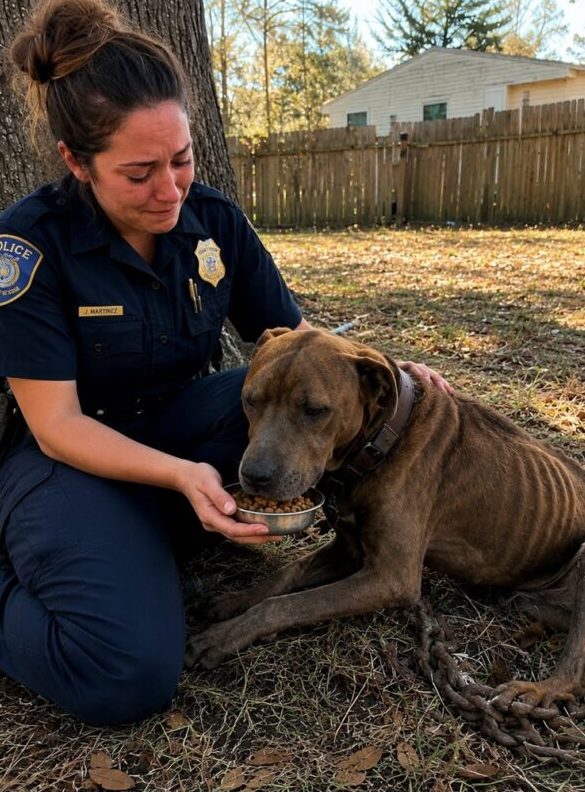
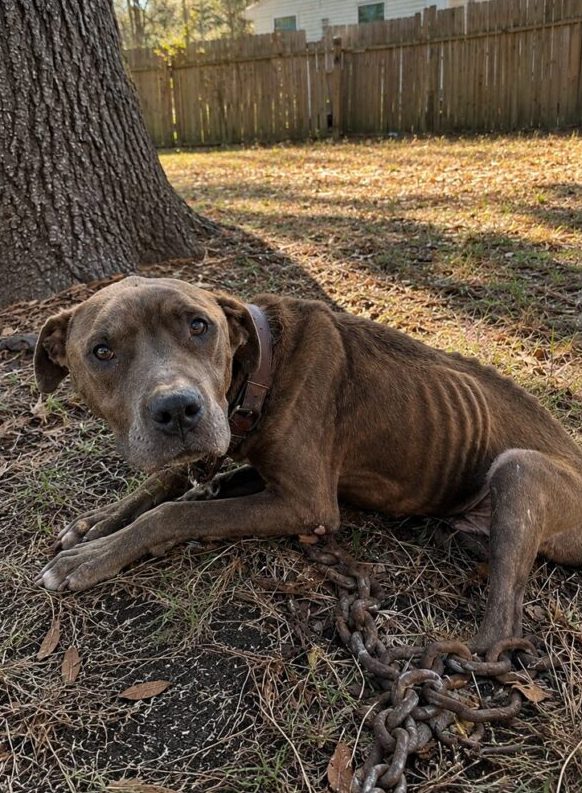
Under a large tree lay a heavy tractor chain. At the end of that chain was a thin, motionless shape, almost unreal. He looked like a dog that life had forgotten.
His ribs were visible under the skin. His coat was dirty, matted, and dull from years of neglect. His eyes no longer even asked for help. They were the eyes of a creature that had stopped hoping.
The owner, a man about sixty years old whom I later identified as Mr. D., did not even call him by name.
To him, he was simply “the dog.”
Not Max. Not Buddy. No companion.
Just “the dog.”
Eight years and four months tied to the same tree. A twelve-foot chain for an entire lifetime. Twelve feet to sleep, eat, survive, and wait.
Then I came closer.
Then I saw his collar.
An old piece of leather, so deeply embedded in his neck that it had begun to grow into the skin on the left side. The surrounding flesh was irritated, wounded, and infected. My throat tightened.
I wondered how he was still breathing.
How he could still sit upright.
How a living being could endure so much pain without biting, without growling, without completely giving up.
I knelt down in front of him.
He did not back away.
He just looked at me.
And in his eyes was something I will never forget.
No anger.
No hatred.
Only a terrible exhaustion… and one silent question:
“Have you finally come to get me?”
When I picked up the tool to cut his chain, my hands were shaking.
The metal broke with a sharp snap.
After eight years, he was free.
But he did not run away.
He did not pull.
He did not even look at the road.
He took two slow steps toward me, as if he did not dare to believe that his body was his own again.
Then he sat down at my feet.
And he laid his head on my knees.
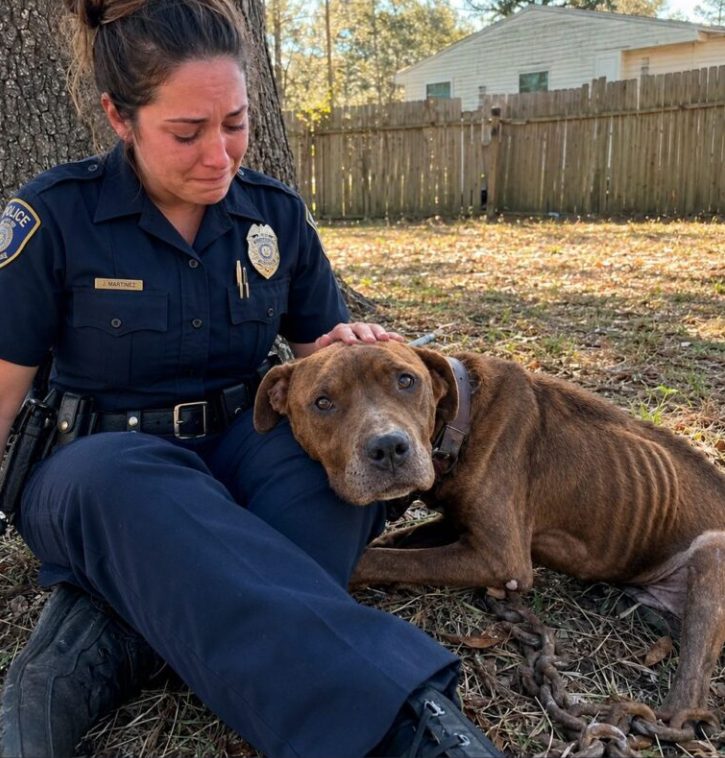
At that moment, I was no longer a uniformed officer. I was just a woman kneeling in the dust, holding a broken dog against me… a dog who had waited eight years for a single sign of kindness.
And what we discovered afterward shocked the entire county.
When I gently lifted his head, he made a sound so soft that I almost missed it.
No bark.
No growl.
A sigh.
As if his body had been holding its breath for eight years.
I wrapped him in a blanket and called the veterinary clinic before loading him into my truck. Emily stood by the gate, her hands over her mouth, tears streaming down her face.
— Will he survive? — she asked.
I looked at the dog in my arms. He was so light that it frightened me.
— I will do everything I can — I told her.
At the clinic, the vet looked once at his neck and fell silent. That silence scared me more than any words. The collar had to be removed slowly and carefully, because the skin around it had grown over it in places. He had infections, old scars, weak muscles, parasites, and signs of years of starvation.
But despite everything, he had never bitten.
Not once.
When the vet touched his wounds, he only turned his eyes to me, as if asking whether I would stay.
So I stayed.
For hours I sat next to the metal exam table, my hand near his paw. Every few minutes, he moved just enough to touch my fingers.
Then Emily’s mother arrived.
She had driven her daughter there, but Emily initially refused to go inside. She stood outside by the clinic window, staring at him, as if afraid he would disappear if she looked away.
Finally I opened the door and called her inside.
The dog was now lying on a clean blanket. His neck was bandaged. His body trembled with exhaustion, but when Emily entered the room, something changed.
His ears went up.
Just a little.
Emily froze.
Then she whispered: “Hey, boy.”
His tail moved once.
Just once.
But to us, it felt like a miracle.
Emily burst into tears. She knelt beside him and covered her mouth to keep from startling him with her sobs.
— I’m sorry — she whispered. — I’m so sorry I couldn’t save you sooner.
The dog slowly stretched out a paw toward her.
At that moment, everyone in the room understood the truth.
She was not just a girl throwing food scraps over the fence.
For eight years, she was the only reason the dog had stayed alive.
The investigation that followed revealed more than anyone expected. Neighbors admitted they had seen him tied up for years but did not want to “cause trouble.” Some said they thought someone else had already reported it. Others said they had gotten used to seeing him there.
Used to it.
Those words haunted me.
Because suffering should never become part of the scenery.
Mr. D. was charged with animal cruelty and neglect. But while the paperwork moved through the system, I could only think about the dog lying in the clinic, learning for the first time that hands can heal instead of hurt.
We gave him a name.
Hope.
At first, Hope did not understand beds. He slept on the floor next to the soft blanket we had laid out for him. He did not understand toys. He flinched when a ball rolled toward him. He did not understand open doors either. Freedom frightened him.
Every time someone opened the kennel, he looked down, waiting for a chain that was no longer there.
But slowly, day by day, he changed.
He learned that food comes every morning.
He learned that the water bowls are always full.
He learned that voices can be soft.
And he learned that when Emily came to visit after school, the world became safe.
She visited him almost every day.
She read books next to him. She brushed his coat. She sat on the floor and told him about school, homework, the birthday party that did not really matter to her, because all she wanted was for someone to listen to her.
And Hope listened.
A month later, when the court released him for adoption, people from all over the county called about him. Families wanted to take him in. Rescue groups offered help. Suddenly, everyone wanted the dog that for eight years no one had noticed.
But Hope had already chosen.
The day Emily walked into the shelter with her mother, Hope stood up before anyone could say a word.
His tail began to move.
Not once.
Not weakly.
It moved as if his entire broken heart had finally remembered what it was like to hope.
Emily’s mother signed the adoption papers with tears in her eyes.
— I should have listened to her sooner — she said softly.
Emily knelt, opened her arms, and Hope walked straight into them.
No chain.
No fear.
No tree.
Just a girl who had loved him in silence for eight years… and a dog who had waited long enough to finally go home.
As they left the shelter, Hope stopped at the door and looked back at me once.
For a moment, he looked at me with those same tired eyes I had seen under the tree.
But this time, something was different.
There was no longer any question in his eyes.
Only peace.
Then he followed Emily into the sunlight.
And I stood there, crying like a child, because sometimes saving is not a heroic moment.
Sometimes saving is a fourteen-year-old girl who refused to forget a dog that everyone else had already forgotten.