The first week was the hardest. I arrived every morning at eight and sat on the steps, about three meters from Dusty. I had with me a small bag with a piece of bread, a bowl of water, and sometimes a few pieces of boiled chicken. I put the food between us, exactly in the middle, and then I simply sat.
I didn’t talk much. Just a few words. “Good morning, Dusty. My name is Evelyn. Nice weather today, isn’t it?” He didn’t look at me. He looked at the door. But he knew I was there. I felt it. Sometimes his ears moved slightly when I spoke, but he never turned. On the third day I noticed he had eaten the chicken. On the fourth day he ate while I was still sitting. Small steps.

People came and went. Some even left food. A young woman named Megan, who worked in the courthouse archives, told me she saw Dusty every day from her window. “He never leaves,” she told me. “Even when it rains. He stays sitting there and lets himself get soaked.”
I thought about it at night in bed. I imagined Dusty in the rain, sitting on the steps waiting for a man who would not come. And it hurt my heart. Not only for Dusty, but also for Robert, that young man who, despite his mistakes, loved his dog so much that the dog was willing to wait for him for a lifetime.
Once I tried to get closer. Very slowly, very slowly I took a step toward him. Dusty stood up immediately. He didn’t growl, didn’t bark. He simply looked at me, and in that look there was something that made me stop. It wasn’t a warning, it was a plea. “Please, don’t force me to leave. I must stay here. He will come back.”
I stepped back. “All right, Dusty,” I said. “I won’t force you. We have all the time in the world.”
The second week I started talking more. I talked to him about my life. About my garden, where roses bloom in spring. About my kitchen, where I make cookies. About Henry. I told him how Henry brought me a small bouquet of flowers picked in the garden every Sunday. How he always told me I was his ray of sunshine. How, for six years, I woke up and the first thing I did was look at that side of the bed where he is no longer.
“I understand you, Dusty,” I said one morning when the rain was streaming down the steps and we were both soaked. “I too know what it is to wait.”
The third week something changed. I arrived as usual at eight. But this time Dusty looked at me. Not for a second, but longer. He looked at me, and I saw in his eyes something that wasn’t there before. Curiosity. Or perhaps recognition. He recognized me. I was no longer just a passerby, I had become part of his day. That day I decided to sit a little closer. Two meters. He accepted it.
The fourth week I sat a meter away. He still looked at the door, but when I spoke, his ears turned toward me. He listened. He listened to me. One day, while I was telling him about my garden, he suddenly lay down. No longer farther away, right where he was sitting. He lay down and rested his head on his paws. It was the first time I had seen him lying down. He always sat upright, always alert, always ready. But in that moment he lay down. And I knew it was a sign of trust.
The fifth week it rained. A heavy rain. I arrived as usual with my raincoat and my bag. Dusty sat on the steps, completely soaked, but he didn’t move. I sat next to him. A meter away. Then fifty centimeters.
“Dusty,” I said, “I know you’re waiting. And I’m not asking you to stop. But I want you to know: if one day you’re tired, if you want a warm place, my door is open for you.”
He looked at me. And this time he didn’t look away. He looked at me long and deeply, as if trying to understand whether I meant it. Then he looked back at the door. But that evening, when I left, I turned around. And Dusty followed me with his gaze. For the first time.
The sixth week I arrived and Dusty was standing. He was at the top of the steps, but when he saw me, he took a step down. A single step. But it meant everything. I sat in my usual place. He sat next to me. Not a meter away, but right beside me. I felt the warmth of his body. I didn’t move. I barely breathed, for fear of ruining that moment.
“Good morning, Dusty,” I whispered. He turned his head slightly toward me and then looked at the door again. But he stayed sitting next to me. He stayed.
On the 43rd day the sun was shining. I arrived as usual, but a little later because I had stopped at the store to buy a small package of dog biscuits. Climbing the steps, Dusty looked at me. He looked at me, and his tail wagged. Weakly, cautiously, but it wagged.
I sat next to him. He didn’t move. I took out a biscuit and placed it on the palm of my hand. He looked at the biscuit, then at me, and then at the biscuit again. And then he took it. From my hand. I felt his warm breath on my palm and my eyes filled with tears.
“You’re a good boy, Dusty,” I said. “You’re a very good boy.” We sat like that for almost an hour. I gave him more biscuits. He took them all. Then I stood up. Usually he stayed seated when I stood up. But this time he stood up too.
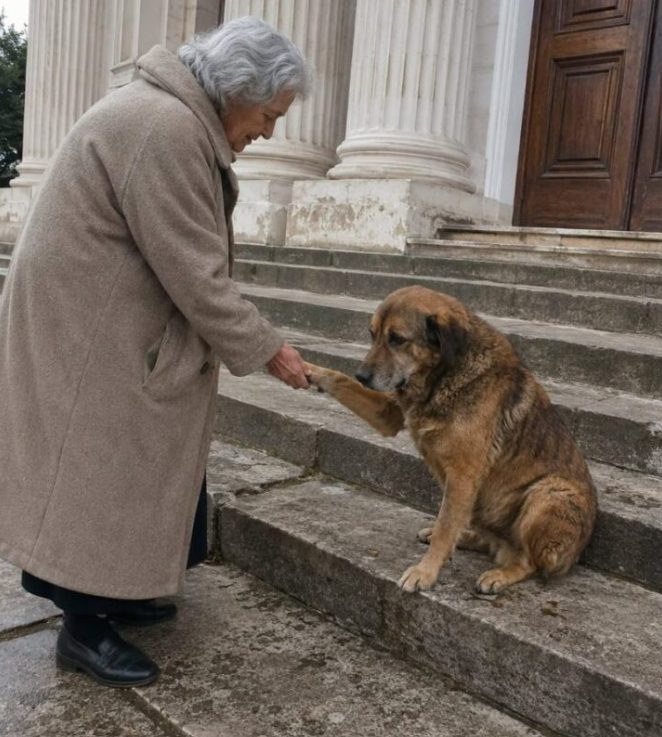
I took a step down. He followed me. One step. I took another. He followed again. I couldn’t believe my eyes. I kept walking slowly and cautiously, and he walked beside me.
When we reached the bottom of the steps, he stopped. He turned and looked at the courthouse door. For a long moment. I saw his body stiffen, as if he were struggling with himself.
“Dusty,” I said gently. “He will understand. He would want you to be safe.”
The dog looked at me. And then, slowly, he turned toward me and resumed walking. We walked together toward my home. The road was long, about twenty minutes. He walked beside me, stopping sometimes, looking back sometimes, but always continuing.
And when we reached the door of my little house, I opened it and invited him in. He entered slowly and cautiously, sniffing every corner. He went around the whole house, as if to verify that it was safe. Then he returned to the living room, where I was standing, and sat down in front of me.
“Welcome home, Dusty,” I said.
The first night he slept near the door. Not because he wanted to go out, but because it was the place where he felt safe. I understood. I gave him an old blanket and he lay down on it. The next morning, when I woke up, he was still there. He hadn’t left during the night. He hadn’t gone back to the courthouse. He had stayed.
The days turned into weeks. Dusty began to change, slowly, very slowly. At first he still spent a lot of time at the window, looking outside as if he were waiting. But little by little he spent more time with me. He followed me into the kitchen when I made tea. He sat next to me when I read. He lay at my feet when I knitted.
One evening, while I was sitting in the armchair looking out the window, Dusty came over. He sat in front of me, looked at me with his deep brown eyes, and then did something that broke my heart and at the same time made it whole. He rested his head on my knees. Just as he had done with his old owner on the steps of the courthouse. But this time it wasn’t a goodbye. It was a greeting.
I stroked his head and tears streamed down my face. “Thank you, Dusty,” I whispered. “Thank you for waiting for me.”
A year has passed since the day Dusty first entered my home. He no longer spends his days at the window. Sometimes he still looks outside, but now he knows that when he turns around, I will be there. He has his cushion near the fireplace. He has his favorite toy, a blue ball I bought him. He has regular meals, warm baths, and every evening a long walk in the garden.
But most of all, he has someone who waits for him. He is no longer the one waiting; he is the one who is awaited.
I learned that Robert Keller, Dusty’s former owner, was released from prison three months ago. Someone had told him about Dusty, about how he had waited 43 days on the courthouse steps and how an elderly woman had taken him in. Robert wrote me a letter. He wrote:
“Thank you. I couldn’t give him what you have given him. I will always love him. But I know he is where he should be. Please tell him I’m all right. And that I will never forget him.”
I read the letter to Dusty. He sat next to me, his head slightly tilted, as if he understood. When I finished, he licked my hand.
I don’t know how much time we have left together. I am seventy-four years old and I know my time is limited. But I also know that these months, this year spent with Dusty, have been the most precious of my life since Henry’s time. He gave me something I thought I had lost forever: a purpose. A reason to get up in the morning. Someone who waits for me. And I gave him something he had lost: a home.
Sometimes, during our walks, we pass by the courthouse. Dusty stops. He looks at the steps. For a moment. Then he looks at me. And we keep walking. He no longer waits. He has found what he was looking for. And so have I.
My name is Evelyn Clark. I am seventy-four years old. And this dog, whose name is Dusty, taught me something I should never have forgotten: love never disappears. It simply changes form. It waits until someone notices it, sits beside it, and says: “I’m here. I’m not leaving.”